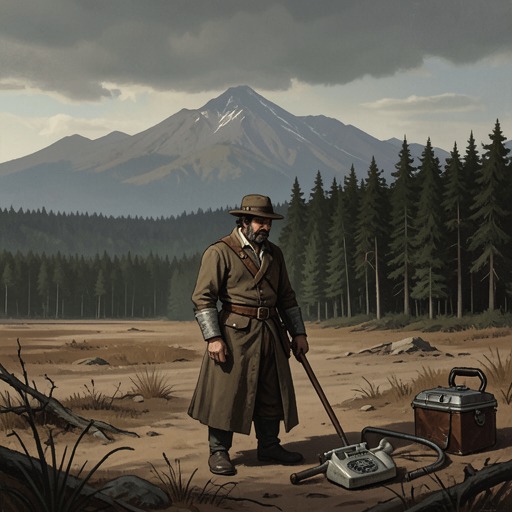
Discovery of the True Narnia
The Last BattleThe discovery of the True Narnia is the decisive reversal at the end of the old world: after its sun has been extinguished and its familiar country apparently destroyed, the survivors learn that Narnia is not dead. The land before them is the real Narnia, more substantial and enduring than the Narnia they knew—a passage from loss into recognition, and from an ending into the beginning of a greater story.
From the Door into a new country
After Aslan opens the Door, the creatures who meet his gaze divide according to their response: some turn away into his shadow, while others enter on his right. Those who come through include creatures thought dead and companions reunited with King Tirian. The company then follows the direction of Aslan’s cry, “Further up and further in,” moving west across a broad, grassy country where many others are travelling without crowding.
The land initially feels both beautiful and difficult to understand. The travellers stop to look around and behind them, drawn by its freshness but puzzled by what they see. Their uncertainty matters: they have not simply returned to the world they lost. The familiar landscape is present, yet altered in a way they cannot at first name.
Recognition in the landscape
Looking south, Lucy notices wooded hills and blue mountains that resemble Narnia’s southern border. Edmund’s recognition makes the resemblance precise: he identifies Mount Pire, with its forked summit, and the pass into Archenland. The likeness is exact enough to orient them, but Lucy also sees that these hills are different—more colourful and apparently farther away than she remembered.
Farsight resolves the uncertainty from above. He spreads his wings, rises thirty or forty feet, circles, and lands with the news that he has seen Ettinsmuir, Beaversdam, the Great River, and Cair Paravel shining beside the Eastern Sea. His conclusion overturns the company’s assumption that the country they loved has perished: “Narnia is not dead. This is Narnia.” The revelation is not a prediction of restoration; it is a recognition of where they already are.
The old Narnia and its reality
Peter objects that Aslan had told the older children they would never return to Narnia, while Eustace recalls seeing it destroyed and its sun put out. Digory distinguishes the Narnia they expected to revisit from the country before them. Aslan’s warning concerned the former: a world with a beginning and an end, which Digory calls a shadow or copy of the real Narnia. In his account, that deeper country has always been and will always be, just as England and the ordinary world are shadows of something in Aslan’s real world.
This explanation reframes rather than denies the destruction. The old Narnia really did end; it was not secretly left intact as a recoverable kingdom. Yet what mattered in it—the beloved creatures and country—has been drawn through the Door into the real Narnia. The survivors can therefore grieve for the ended world without treating its end as the annihilation of everything it contained.
The narrator makes the distinction through an image of reflection. A sea or valley seen in a mirror is recognisably the same landscape as the view through a window, yet seems somehow deeper and more like a place in a story. The new Narnia bears that relation to the old one: it is not merely a duplicate, but a country in which each rock, flower, and blade of grass seems to mean more. The image gives the revelation a perceptual form: the travellers recognise what they knew, while discovering that its reality exceeds their former understanding.
Homecoming and onward movement
Jewel gives the recognition an intimate, personal voice. The Unicorn declares, “I have come home at last! This is my real country!” He understands that the old Narnia was loved because it sometimes resembled this truer home, though he had not known what he was seeking. His response makes the difference between the two countries more than a matter of scale or scenery: the new land answers a longing that the old one could only awaken.
Jewel breaks into a gallop and calls for the others to come farther in. The whole company runs after him, and even Puzzle and Poggin keep pace; no one grows hot, tired, or out of breath. The movement carries the discovery forward rather than turning it into a final resting point. The recognition of the real country opens a continuing journey into it.
An ending that becomes a beginning
The cosmic destruction that precedes this discovery gives its recognition its full weight. Aslan calls the stars home; a spreading darkness reveals that the stars have left the sky. Later, when Aslan says to make an end, the Time-giant extinguishes the sun, and the old world falls into darkness. The True Narnia is therefore not a political restoration after catastrophe but the country disclosed beyond the closure of that world.
The final explanation extends this pattern to the children’s own lives. Aslan tells them that a real railway accident has killed them and their parents; the end they feared is instead described as a beginning. Their lives in the ordinary world and their adventures in Narnia have been only the cover and title page of the Great Story. The discovery thus completes one narrative by opening another: Narnia’s apparent death becomes entry into enduring reality, and the survivors’ arrival is only the first chapter of a story that continues without end.